FL Explainer

Oil & Gas

PLAY PAUSE
0:00
/
PLAY PAUSE

Confidential Сomputing for Machine Learning in the Oil and Gas industry

Customer

A group of companies consisting of more than 20 enterprises  in the field of diagnosing flow and integrity throughout the oil and gas well system, from the wellbore to the reservoir, empowering their customers to make better decisions and improve asset performance.

The Customer invests a significant portion of annual revenues into R&D, collaborating with universities and industry partners to advance diagnostics. Their in-house expertise spans program design, data acquisition, tool and sensor manufacturing, software development, and data interpretation, establishing the Customer as a unique and trusted leader in through-barrier diagnostics.

Among the Customer specialties are:
  • Through-barrier diagnostics
  • Well & reservoir flow assessment
  • Well integrity assessment
  • Field-wide reservoir assessment [multi-layer, cross-well]
  • Measurement modeling
  • Oil and gas, and energy

Challenge

All oil workers are very protective of their data. Access to data is strictly guarded, and this occurs not only between competing companies but also between subsidiaries and even within the same company, between different departments developing various fields. Maintaining the confidentiality of such data is the number one priority. In some cases, the situation is exacerbated by the fact that data cannot leave the borders of certain countries by law.

On the other hand, companies are actively developing predictive diagnostics for well operations using artificial intelligence methods. A clear obstacle to the development of ML algorithms is the unwillingness or inability of data owners to share their data with ML developers due to potential threats such as leaks, theft, and illegal use.

During the extraction and storage of gas, gas condensate, and oil, operators around the world face the problem of sand production from wells.

Sand production leads to equipment failure, reduced well productivity, and increased operational costs.

This problem is acute in the oil and gas industry, both at production wells and underground oil and gas storage facilities.

The solution is a system with ML models for detecting sand production at oil and gas production and storage facilities, trained on a large amount of data from various sources

Thus, to comply with confidentiality requirements and train the models, relevant data owned by different entities was exchanged in encrypted form.

It is important to emphasize that the data was protected throughout the entire process, including the stages of machine learning and inference.

Fully Homomorphic Encryption by Guardora

Protection of all important data on the owner’s side
Transmission of protected data to the ML team
Storage of protected data
Training the ML model on protected data
ML model quality check on protected data
Return model result in protected form
Withdrawal of protection and interpretation of the results obtained by the data owner
Inference

Solution

Machine learning on encrypted data.

Guardora achieved full training of the ML model on encrypted data followed by inference on encrypted samples

In addition, if the model is decrypted, it will be applicable for inference on public data with the same characteristics. This is useful when the model is trained in the cloud or on third-party encrypted data and then used on its computational resources or its unclassified data
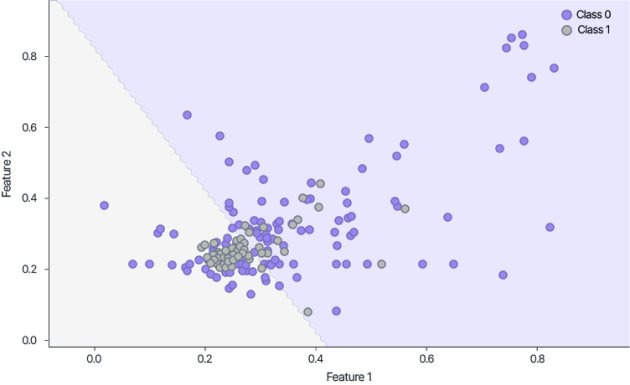
Accuracy = 0.73585
Training result on open data for logistic regression with two parameters
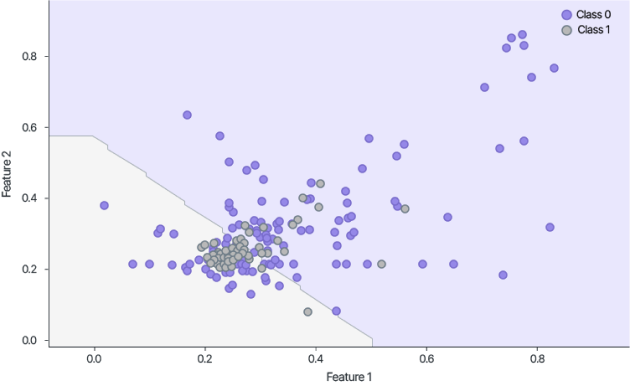
FHE Accuracy = 0.72453
Training result on Fully Homomorphic Encrypted logistic regression data with two parameters
Inference of encrypted data.

Guardora also trained the model on public data and then adapted it for the inference of encrypted samples

This was useful for a training sample that did not contain sensitive information, but the data that were processed subsequently were sensitive
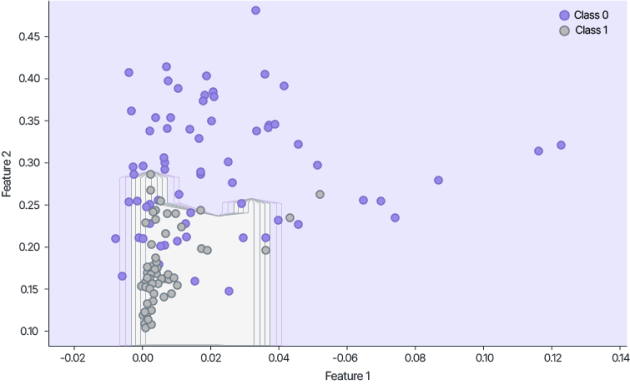
Accuracy = 0.86792
Inference result of unencrypted samples on an XGBoost classifier trained on public data with two parameters
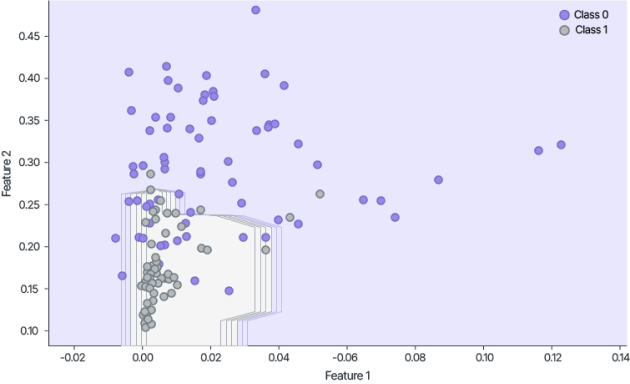
Accuracy = 0.84960
Inference result of FHE-encrypted samples on an adapted XGBoost classifier trained on public data with two parameters

Results

 In the pilot project, 4 companies participated (the Customer, 2 end users, and Guardora)
The volume of sand production data for joint training came from 11 wells of 2 end users.
Geophysical data did not leave the trusted boundaries of the data owners; the exchange was carried out only with encrypted values.
A joint model was formed on the server based on the encrypted model information from both users.
The accuracy of the joint sand detection model increased from 70% to 85%.
Significant adjustments were made to the well workover planning for 3, 6, and 12 months.
Unplanned workovers were minimized.
Well downtimes waiting for workovers were reduced.
Environmental impacts caused by hydrocarbon leaks were eliminated.
The direct savings and optimized costs due to the predictive analytics of well condition amounted to approximately US$ 200 million per year.
Work on predicting corrosion development in wells was planned.

FAQ

What problem does this Oil & Gas case study solve?
The case study addresses two interlocking problems in the oil and gas industry.
1. Sand production from wells — sand carried out of wells during extraction or storage causes equipment failure, reduced productivity, and higher operational costs. The solution is ML-based predictive diagnostics.
2. Data confidentiality blocking ML development — oil and gas companies are extremely protective of geophysical well data, both because of competitive sensitivity and because some jurisdictions legally prohibit data crossing national borders. Without a way to share data securely, ML teams can't train effective models. Guardora's Fully Homomorphic Encryption (FHE) resolves both: enables joint ML training on encrypted data so multiple data owners can collaborate without ever revealing the underlying records.
How does Fully Homomorphic Encryption work in oil & gas data sharing?
The workflow has seven stages, executed end-to-end on encrypted data:
1. Data owners encrypt geophysical well data on their own infrastructure using FHE.
2. Encrypted data is transmitted to the ML team.
3. Storage of encrypted data on the training infrastructure.
4. ML model training proceeds directly on encrypted data — the training infrastructure never sees plaintext.
5. ML model quality check, also on encrypted data.
6. Return of model results in encrypted form.
7. Withdrawal of encryption and interpretation by the data owner. Crucially, geophysical data never leaves the trusted boundaries of the data owners in unencrypted form, satisfying both contractual confidentiality and any applicable data-localization laws.
What are the accuracy results — does FHE degrade ML performance?
The accuracy loss from FHE is small. Logistic regression with two parameters: training on open data achieved 0.73585 accuracy; training on FHE-encrypted data achieved 0.72453 — a loss of ~1.5 percentage points. XGBoost classifier: inference on unencrypted samples achieved 0.86792; inference on FHE-encrypted samples through an FHE-adapted XGBoost achieved 0.84960 — a loss of ~2.1 percentage points. The joint sand detection model (multiple data owners pooling encrypted data) raised accuracy from 70% to 85% — a 15-percentage-point gain that comes from larger combined training data, far outweighing the small FHE accuracy cost. This is the central finding: FHE's modest accuracy cost is dwarfed by the accuracy gains from multi-party data pooling.
Why use FHE instead of federated learning for oil & gas?
Both techniques have valid uses; this case chose FHE for specific reasons. FHE strengths in this scenario: (a) the trained model itself remains encrypted and applicable to encrypted inference, useful when the model is trained in the cloud or on third-party data and then deployed on either unclassified data or in a different infrastructure; (b) protection covers the full pipeline including training and inference, not just gradient transmission; (c) the data owners retain absolute cryptographic control over their data — the ML team never sees anything decrypted. Federated learning (e.g., Guardora VFL) is preferred for vertical collaborations between two parties combining different feature columns about overlapping entities (bank + credit bureau scoring the same customers). For multiple oil & gas data owners pooling similar feature columns about different wells, FHE was the better fit.
What was the business impact of this deployment?
The pilot project involved 4 companies (Customer + 2 end users + Guardora) training on data from 11 wells. Concrete outcomes: (a) Joint sand detection accuracy raised from 70% to 85%. (b) Significant revisions to well workover (capital repair) planning across 3, 6, and 12-month horizons. (c) Unplanned workovers were minimized. (d) Well downtimes waiting for workovers were reduced. (e) Environmental impacts from hydrocarbon leaks were eliminated. (f) Direct savings and optimized costs from predictive well analytics: approximately US$200 million per year. (g) Follow-up work on predicting corrosion development in wells is planned. The $200M figure makes this one of the highest-ROI privacy-preserving ML deployments publicly documented in the oil and gas sector.
Which ML algorithms work with Guardora FHE — only logistic regression?
The case study demonstrates two algorithms in production: logistic regression (full FHE training and inference end-to-end) and XGBoost classifier (FHE-adapted, where training is on public data and inference is on encrypted data). Guardora's FHE implementation is being extended to additional tabular ML algorithms based on customer requirements. Important caveat: FHE computational cost grows with model complexity. Deep neural networks remain challenging under fully homomorphic schemes due to non-linear activation functions, though research on FHE-friendly approximations is active. For tabular ML use cases like sand detection, logistic regression and tree-based classifiers strike the right balance between accuracy and computational feasibility under FHE.
Can FHE handle data residency / data localization laws?
Yes — this is one of FHE's strongest legal arguments. Data never leaves its origin jurisdiction in cleartext. Encrypted data crossing borders is treated differently under most data-protection regimes (GDPR Article 4(1) refers to "identified or identifiable" natural person — encrypted data that cannot be re-identified is generally considered outside the personal-data scope per GDPR Recital 26). Russian Federal Law 152-ФЗ on personal data localization is similarly satisfied: the personal data physically remains within Russian infrastructure; only encrypted computation outputs traverse boundaries. For pharma, healthcare, and oil & gas — sectors with severe localization requirements — FHE often represents the most compliant approach to multi-party ML collaboration.
How does this case relate to Guardora's other products like VFL?
Guardora's commercial offerings cover multiple privacy-preserving ML primitives. Guardora VFL (Vertical Federated Learning) is the flagship product for two-party collaborations on tabular ML — for example, a bank and credit bureau combining feature columns. Guardora's FHE capability (demonstrated in this oil & gas case) is a separate but complementary primitive for scenarios where end-to-end encryption of the full ML pipeline is required. Guardora FFT (Federated Fine-Tuning) covers fine-tuning of foundation models in federated mode. These primitives are selected per use case — sometimes deployed in combination. For oil & gas data owners considering a similar deployment to this case, contact Guardora for a scoping session to determine the optimal primitive mix.