boosts machine learning model performance
Guardora VFL is a commercial Vertical Federated Learning platform that lets two organizations jointly train tabular ML models — such as credit scoring or fraud detection — on each other's data without sharing the underlying records or labels.
It supports Gradient Boosted Decision Trees and Logistic Regression
on tabular data, uses Paillier homomorphic encryption (1024-bit) for gradient protection, and exposes a REST API for integration into existing ML pipelines.
Validated workloads include credit scoring with ROC AUC ≈ 71.3 and 0.817 → 0.975 accuracy gains in production deployments.
Guardora VFL is a commercial Vertical Federated Learning platform that lets two organizations jointly train tabular ML models — such as credit scoring or fraud detection — on each other's data without sharing the underlying records or labels.
It supports Gradient Boosted Decision Trees and Logistic Regression
on tabular data, uses Paillier homomorphic encryption (1024-bit) for gradient protection, and exposes a REST API for integration into existing ML pipelines.
Validated workloads include credit scoring with ROC AUC ≈ 71.3 and 0.817 → 0.975 accuracy gains in production deployments.


Guardora VFL leverages federated learning technology to enhance ML model accuracy by training on previously inaccessible external data — without the data ever leaving its owner's secure perimeter.
By implementing Guardora VFL, businesses increase revenue through more powerful predictive models.
The solution specializes in tabular data processing.
Explore the Guardora VFL API documentation for implementation details.
A fragment of Swagger UI with Guardora VFL API:
node
get
/node
Get Node Info
post
/node
Post Node
delete
/node
Delete Node
get
/node/public_key
Generate Node Public Key
post
/node/start
Start
post
/node/stop
Stop
remotes
get
/remotes
List Remotes
post
/remotes
Add Remote
delete
/remotes/{remote_name}
Remove Remote
get
/remotes/{remote_name}/check_connection
Check Connection
projects
post
/projects/{project_name}
Create
Delivery format
Access to the repository
How to install
On each participating party perform the following steps:
Intuitive REST API
Use the product’s friendly API to perform model training and inference. Or integrate it into your ML-pipeline
Who plays?
You test solo or with partners
Data
Your data, as well as data from your partners. We can provide our test data
Infrastructure and Security
On-premise or private cloud.
The client itself establishes the necessary security level, and obtains full control over data and processes
Scalability
Scalability within the client's internal infrastructure
Pricing
“Pay-As-You-Infer” licensing model with postpayment - monthly licensing fee based on the number of useful requests (received predictions from federatively trained model)
Support
Guardora’s support is included in the license fee

Dataset synchronization (Private Set Intersection, PSI), training, validation, inference (with homomorphic encryption)
Dataset synchronization (Private Set Intersection, PSI), training, validation, inference (with homomorphic encryption)
Method of obtaining the data table (e.g., CSV file, SQL connection to a database). Implemented by the client
Homomorphic encryption
Method of obtaining the data table (e.g., CSV file, SQL connection to a database). Implemented by the client
Required for high-load inference >300 RPS
Required for high-load inference >300 RPS
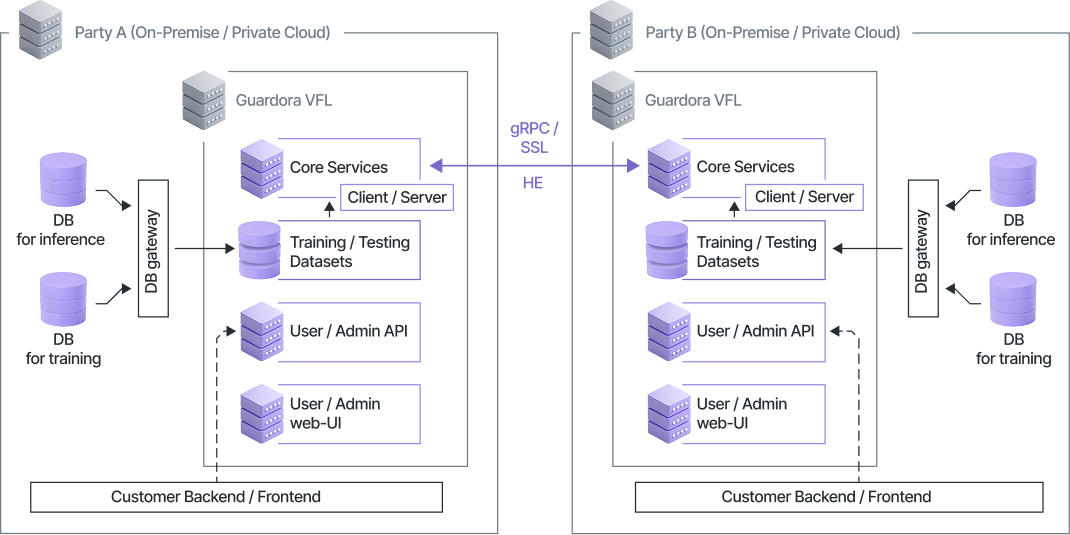
Dataset synchronization (Private Set Intersection, PSI), training, validation, inference (with homomorphic encryption)
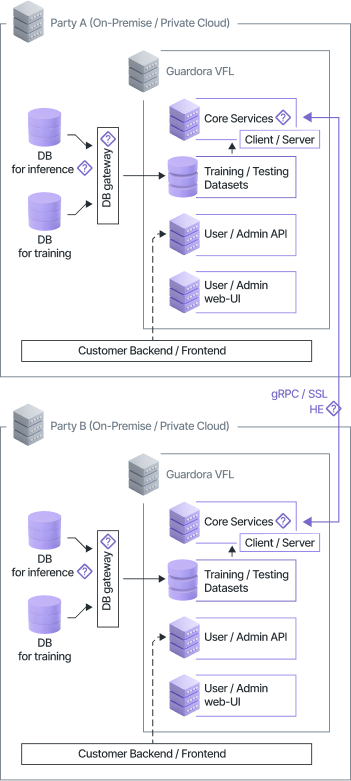
Dataset synchronization (Private Set Intersection, PSI), training, validation, inference (with homomorphic encryption)
Method of obtaining the data table (e.g., CSV file, SQL connection to a database). Implemented by the client
Method of obtaining the data table (e.g., CSV file, SQL connection to a database). Implemented by the client
Homomorphic encryption
Required for high-load inference >300 RPS
Required for high-load inference >300 RPS
Credit bureaus, Scoring providers, Banks and microfinance organizations, Insurance companies, Payment systems, Telecom operators
Developing new products that require combining data from several companies
Scoring providers, Fintech companies
Overcoming internal barriers to data exchange between companies within a group
Creating unified models for the entire group
Fintech holdings, Groups of companies, including cross-border
Rapid testing of hypotheses on real data of potential clients
Demonstration of the value of the product without the risk of data leakage
Scoring providers, Providers of solutions for working with personal data
Guardora VFL allows training ML models on data from multiple companies while preserving the confidentiality of each company's data. Using a credit scoring model as an example, this means that:
With a better model the client company receives additional revenue through more accurate customer segmentation, reduced defaults, and optimized credit decisions.
Based on the described effect, Guardora offers a transactional “Pay-As-You-Infer” licensing model with postpayment with the following parameters:

Reduction in overdue debt level and increase in lending volume through more accurate scoring

Credit portfolio optimization and increased profitability through improved risk management

Improved underwriting decisions through accurate risk calculation

Increased number of requests and higher product value due to improved scoring model accuracy
To test the demo version of the product and find out the pricing conditions, fill out the form and we will contact you