

**The Internet of Things (IoT) and Industrial Internet of Things (IIoT) operate across three architectural levels — sensors collecting raw data, hubs aggregating it, and software making decisions — creating multiple attack surfaces for sensitive data.** Privacy-Preserving Machine Learning (PPML) protects all three levels: Federated Learning trains models on distributed sensor streams without raw data transfer; Confidential Computing secures upper-level processing in hardware-isolated environments; Secure Multi-Party Computation enables cross-organization analytics. Real Guardora cases: predictive industrial equipment maintenance, vehicle telematics for insurance scoring, large automotive user cohort analytics, environmental monitoring — all without exposing sensitive sensor data.
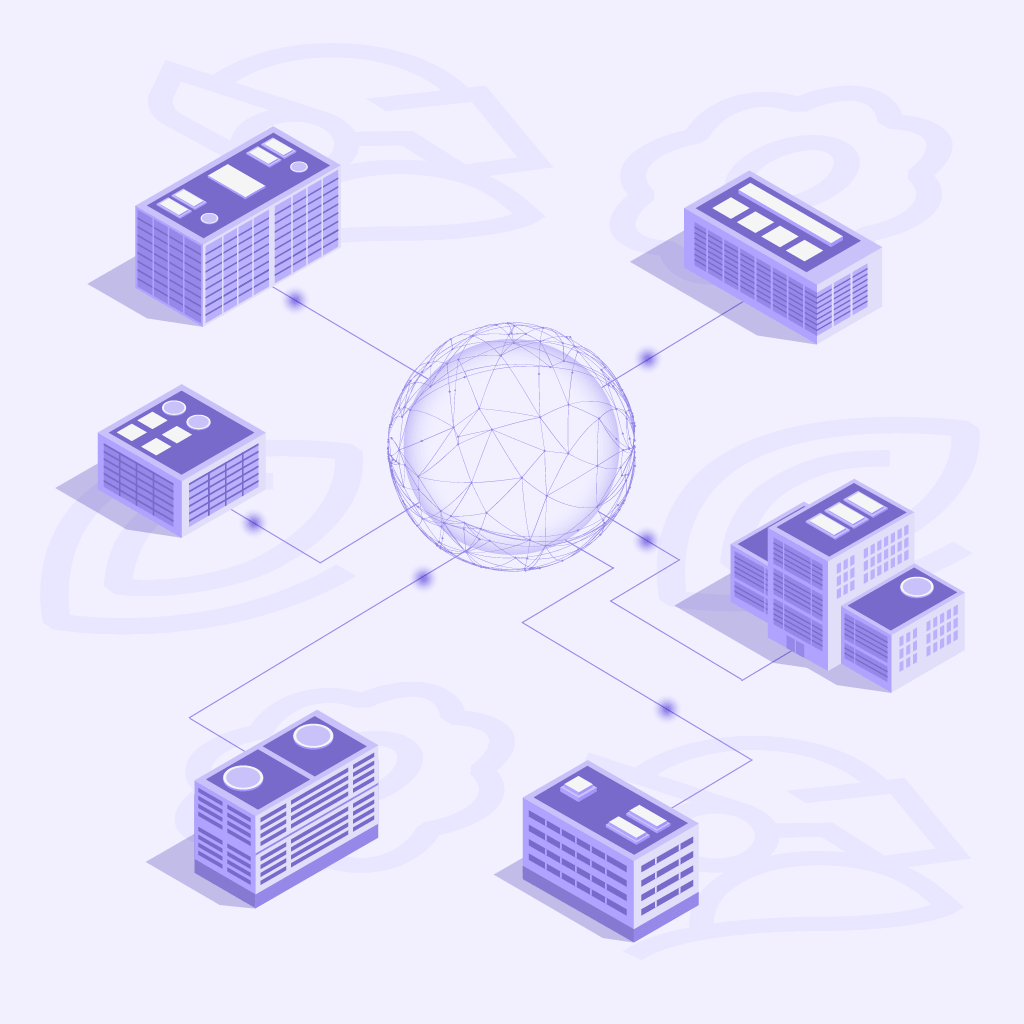
In a broad sense, the Internet of Things (IoT) refers to the concept of interaction among physical objects across three levels.
Lower Level: Sensors that continuously record various quantitative indicators such as temperature, pressure, and levels within human environments, devices, and the surrounding world.
Middle Level: Transceivers and hubs that collect, store, and transmit data from the lower to the upper level.
Upper Level: Software that interprets the data gathered from the lower level and makes decisions that impact our lives.
This article will focus on Guardora's solutions for protecting IoT data used in Machine Learning.
Sensitive Data in the Internet of Things
Broadly speaking, sensitive data includes any information that can be used for unauthorized actions against individuals and companies.
In the Internet of Things (IoT), examples include geolocation data, health metrics from wearable devices, biometric information, and the technical status of personal vehicles and other gadgets.
In the Industrial Internet of Things (IIoT), sensitive data encompasses any information from devices, assets, and fields that is deemed confidential.
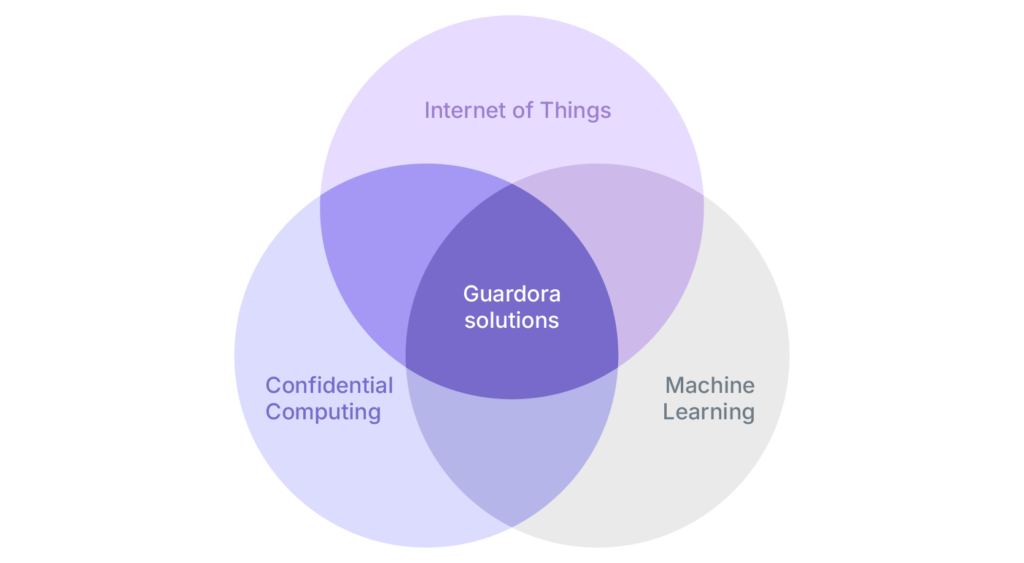
Here are some cases where we encountered the combination of all three domains: IoT, ML, and Confidential Computing
- Predictive analytics models for industrial equipment status. Streaming data from sensors that allow you to tell how soon a machine will fail. The goal is to prevent the moment of failure or advise the operator-technician on what must be done to improve the repair and maintenance process.
- Predictive risk assessment models for drivers of various vehicles. These models assess risks associated with drivers of all types of vehicles, from scooters to cars, for the purpose of insurance scoring. The primary data set is collected through a mobile application. The type of mobility is determined using real-time data on speed, gyroscope acceleration, and route geolocation. The data includes GPS coordinates, speed, direction of movement, accelerometer readings on three axes, details about the user’s movements, and any accidents they have been involved in. These data sources include companies selling car alarms with tracking functions and some corporate clients. Car alarm vendors often segment tracks into short pieces, believing that monitoring stop points of individuals can eventually identify them—revealing where they live, work, etc. Even without knowing the person's name, there is a good chance of indirectly identifying the user, leading to potential privacy issues. This track segmentation, however, makes the data very cumbersome to use.
- Large automotive data. The value of large automotive data extends beyond assessing traffic accident risks to identifying commercially useful patterns. These include where people drive, stop, shop, and refuel. By uncovering such patterns, it is possible to form user cohorts of interest to third-party companies, retailers, oil companies, and entertainment providers. These large datasets are collected by major independent companies and processed using secure multi-party computation protocols or federated learning methods.
- Environmental monitoring. On one hand, the government, scientists, and society are interested in improving the quality of ML models. However, companies that significantly impact emissions are reluctant to share open data due to fears of leaks, sanctions, and reputational damage.
This topic and market are vast and leave many open questions to address, such as:
- Is it advisable to combine data protection and preprocessing using ML methods at the lower and middle levels? Or is it sufficient to encrypt data from the lower level for transmission to the upper level, where the full processing cycle can be performed?
- For which IoT tasks is data anonymization sufficient, and in which cases is it necessary to ensure the confidentiality of every byte of transmitted traffic? How significantly does anonymizing parts of the data degrade the quality of the ML solutions developed from them?
- Is it possible to standardize approaches to data confidentiality to unify the developed software and ensure its operability regardless of the manufacturer of sensors, transceiver devices, and data storage? Or is it impossible to organize interaction without the participation of specialized integrators?
- How can we assess the security of using Edge Computing to save traffic and model response time? And can we even speak of data security in this case?
- Is it possible to combine non-confidential data transmitted in the open with protected confidential data when building ML solutions? Is the approach viable where only part of the data stream is protected, making it impossible to reconstruct the full picture?
If you are interested in experiments on this topic, join our community on Discord to participate in discussions and pilot projects.
Frequently Asked Questions
What is the difference between IoT and IIoT in PPML?
**IoT (Internet of Things)** covers consumer-facing connected devices — wearables, smart home devices, personal vehicles. Sensitive data includes geolocation, health metrics, biometrics, vehicle telemetry. **IIoT (Industrial Internet of Things)** covers industrial connected systems — factory sensors, oil pipeline monitors, agricultural drones, smart grid components. Sensitive data is any device/asset/field information deemed confidential by the operating company. **Privacy challenges differ:** IoT focuses on individual identification risks (geolocation traces, behavioral patterns); IIoT focuses on commercial confidentiality (production data, infrastructure mapping, competitive intelligence). PPML primitives apply to both, but use cases and threat models vary.
How does PPML protect IoT sensor data?
PPML protects IoT data through three complementary mechanisms aligned with IoT's 3-level architecture. **(1) Federated Learning at lower/middle levels** — models train directly on sensor data within the device or hub; only encrypted model updates flow upward. **(2) Confidential Computing at upper level** — software processing occurs in hardware-isolated environments where even cloud operators cannot see plaintext data. **(3) Secure Multi-Party Computation for cross-organization analytics** — multiple IoT operators can jointly compute (e.g., industry-wide predictive maintenance models) without exposing raw sensor data to each other. Edge Computing complements these approaches by minimizing data transmission
Why is IoT data uniquely vulnerable to identification attacks?
Even "small snippets" of IoT data — short GPS tracks, brief sensor readings, transient biometric measurements — can be aggregated to identify individuals. **Concrete example from automotive telematics:** car alarm vendors segment driver tracks into short pieces, believing stop-point monitoring won't identify users. But pattern aggregation (home location, workplace, shopping patterns, refueling habits) creates a unique behavioral fingerprint. Even without a person's name, indirect identification succeeds. **Result:** track segmentation makes data both harder to use (cumbersome for legitimate analytics) AND no safer against re-identification. **PPML's answer:** keep raw tracks on devices; share only encrypted/anonymized model updates that cannot be reverse-engineered to individual paths.
How does Federated Learning work for IoT devices?
Federated Learning (FL) for IoT inverts the traditional centralized training model. **Traditional approach:** sensor data uploaded to central server; ML model trains on aggregated data. **FL approach:** models travel to the data — sensor devices (or local hubs) train models on locally-stored data; only model updates (gradients) flow upward. **For predictive maintenance:** each industrial sensor's data stays on-device; the central server aggregates model updates across all sensors to detect failure patterns. **For vehicle telematics:** driving behavior data stays in the vehicle's onboard computer; only aggregated risk-scoring model updates flow to the insurance provider. **Result:** privacy preserved, bandwidth saved, compliance simplified.
What is Edge Computing's role in IoT privacy?
Edge Computing — processing data on or near IoT devices rather than in central clouds — has natural privacy benefits but isn't automatically secure. **Benefits:** less data leaves the device (smaller attack surface), faster model response times (no roundtrip to cloud), reduced bandwidth costs. **Risks:** edge devices have limited security capabilities compared to cloud infrastructure; physical access to edge devices can compromise stored data; firmware vulnerabilities propagate across thousands of identical devices. **PPML integration:** Edge Computing + Federated Learning is the strongest privacy combination — data stays local, models train at edge, only encrypted aggregations flow upward. Confidential Computing in cloud datacenters protects the upper-level aggregation step.
Can Confidential Computing protect environmental monitoring data?
Yes — Confidential Computing addresses a unique tension in environmental monitoring. **The tension:** government, scientists, and society benefit from better ML models for emissions and pollution monitoring; but companies whose facilities significantly impact emissions refuse to share data due to fear of leaks, sanctions, and reputational damage. **Confidential Computing's solution:** facility emissions data is encrypted and uploaded to hardware-isolated cloud environments. ML models compute on the encrypted data without ever decrypting it. Government regulators can verify model outputs without seeing individual facility data; companies' competitive emissions data stays confidential; aggregate environmental insights flow to public benefit. This unlocks data sharing that has historically been blocked.
How does PPML handle the 3-level IoT architecture?
Each IoT level requires distinct PPML treatment. **Lower Level (sensors):** lightweight encryption + on-device processing (cryptographic limitations apply — small sensors can't run full FHE). Anonymization at source is critical. **Middle Level (transceivers/hubs):** Federated Learning model aggregation happens here; data is encrypted in transit using TLS or equivalent; hubs can run partial cryptographic operations (e.g., Secure Aggregation protocols). **Upper Level (software/cloud):** Confidential Computing protects the full processing pipeline — even cloud operators don't see plaintext. ML inference runs in hardware-isolated environments. **Key strategic question:** is it better to process data privately at lower levels, or encrypt for transmission and process fully at upper level? Pack 32's open question #1 explores this tradeoff.
What are real Guardora use cases for IoT PPML?
**4 documented cases.** **(1) Industrial equipment predictive maintenance:** streaming sensor data identifies impending failures; FL trains models without centralizing proprietary equipment data. **(2) Vehicle telematics for insurance scoring:** driver behavior data (GPS, accelerometer, gyroscope) trains risk models; FL keeps data on-device; insurers get risk scores without privacy violations. **(3) Large automotive user cohort analytics:** patterns of where drivers go, stop, shop, refuel — segmented into commercially valuable cohorts via SMPC + FL; raw individual tracks never centralized. **(4) Environmental monitoring:** facility emissions data analyzed via Confidential Computing; aggregate insights for regulators, individual facility data stays confidential. Each case spans different industry vertical but shares same PPML toolkit.